Ask most talent acquisition leaders what's driving recruiter burnout and you'll get some version of "there's just too much work." That's true, but it's also incomplete. The real problem isn't the volume of work, it's the kind of work. Recruiters aren't burning out from doing the parts of the job that require judgment, relationship-building, and negotiation. They're burning out from doing everything else: manually sourcing, re-entering the same candidate data across systems, chasing status updates, and scheduling and rescheduling interviews.
And the workload keeps climbing. According to SHRM's 2026 Recruiting Executives Benchmarking report — based on data from more than 4,600 organizations — extra-large organizations saw a 67% increase in median requisitions per recruiter in 2026, and over two in three organizations reported ongoing struggles filling open positions. More reqs per recruiter, with no corresponding increase in headcount, is a direct math problem before it's ever a resilience problem.
Where the time actually goes
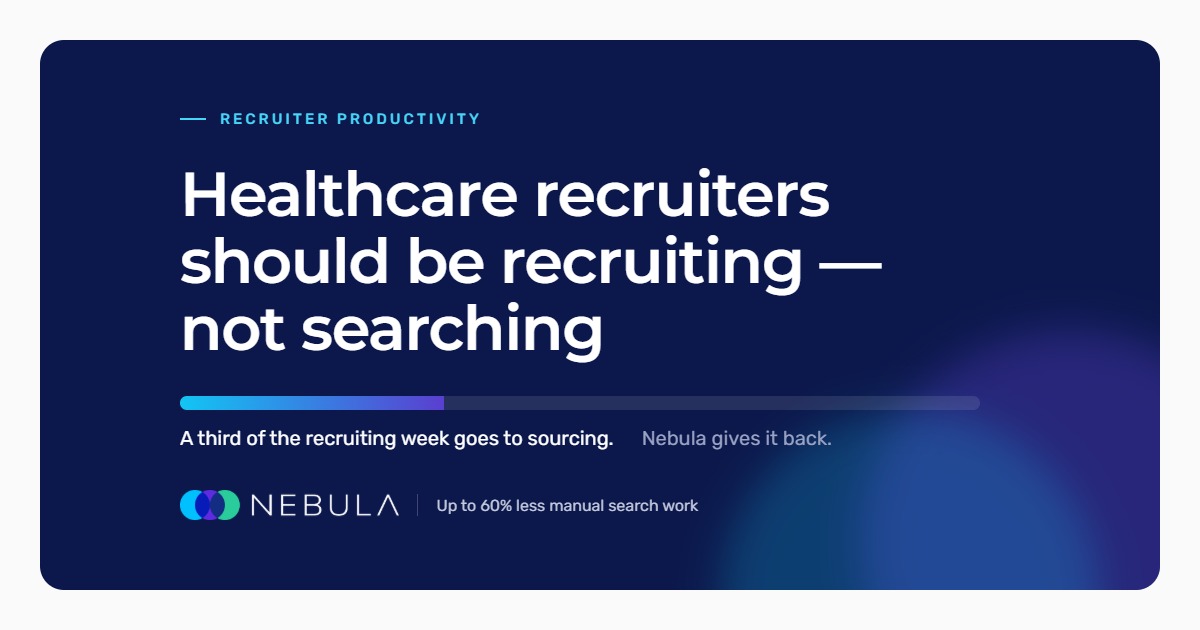
Ask a recruiter to log an honest hour-by-hour account of their week, and sourcing, screening, scheduling, and follow-up will eat most of it — not candidate conversations, not offer negotiation, not the parts of the job that actually require a recruiter's judgment. ERE Media's reporting on HR burnout points to the same pattern from a different angle: in a Karma Check poll of HR leaders, 54% said they'd previously left a job specifically because of hiring and recruiting stress, and roughly half were missing their own cost-per-hire and time-to-fill targets — not for lack of effort, but because the administrative load was crowding out the work that actually moves a req forward.
This is the part that gets missed in most "burnout is bad" conversations: it's not a motivation problem. It's a design problem. When the majority of a recruiter's day is spent on tasks that don't require recruiting skill — data entry, status chasing, calendar tetris — burnout isn't a surprising outcome. It's the expected one.
The Compounding Cost
Here's where it stops being a "soft" HR issue and starts showing up on a P&L. Burned-out recruiters don't just feel worse — they perform worse, and they leave faster:
· Worse placements. A recruiter working reactively, buried in admin, has less time to properly qualify candidates before they're pushed to a hiring manager — leading to weaker shortlists and more re-opened reqs.
· Slower time-to-fill on the roles that matter most. SHRM's benchmarking data shows nonexecutive time-to-fill actually improved to a median of 39 calendar days in 2026 — but that median hides the reality at extra-large organizations juggling the sharpest req-per-recruiter increases, where the workload math is hardest to sustain.
· Higher cost-per-hire. SHRM's same 2026 data showscost-per-hire rising substantially for executive roles — the ones that take themost recruiter time and judgment, and the ones burnout hits hardest.
· Recruiter attrition. Every recruiter who leave stakes their pipeline knowledge and hiring-manager relationships with them — and the org has to spend its own time-to-fill and cost-per-hire budget rehiring fora role it already thought was covered.
The costs above aren'tseparate line items. They compound: a burned-out recruiter makes a weakerplacement, that placement takes longer and costs more, and the recruiter whomade it is more likely to leave before the next req is even filled — at whichpoint the org is paying the sourcing cost twice.
What automation actuallyremoves from a recruiter's day (and what shouldn't change)
The fix isn't "hire more recruiters" — most TA budgets aren't moving that direction in 2026. It's removing the parts of the job that were never a good use of a recruiter's time in the first place. According to Bullhorn's 2026 GRID industry trends report, which surveyed more than 2,300 recruitment professionals worldwide, recruiters using AI-assisted screening report candidate screening running 50–75% faster — time that goes straight back into the parts of the job that actually require a person:client relationships, candidate conversations, and negotiation. The same report found that 56% of top-performing agencies now place candidates in under 10 days— a gap worth reading alongside the screening-speed finding above, since faster, AI-assisted screening is one of the clearest ways to free up the hours a recruiter needs to move a placement that quickly.
That's the actual dividingline worth drawing:
What should be automated: initial sourcing and matching against a role, first-pass screening against role requirements, outreach sequencing and follow-up cadence, interview scheduling, and status updates to candidates and hiring managers.
What should stay human: the actual candidate conversation, reading between the lines onfit and motivation, hiring-manager alignment, and offer negotiation.
Nebula's platform is builtaround that exact line. AI candidate matching surfaces qualifiedcandidates from a 200M+ profile database without manual keyword searching,outreach automation handles the sequencing and follow-up that recruiterscurrently do by hand, and none of it replaces the judgment calls that shouldstay with a person. You can see what that looks like in practice in how Nebula transforms arecruiter's day-to-day.
Recruiter burnout isn't a resilience problem, and it isn't going to be solved with a wellness stipend. It's a workload-design problem, and it shows up in the numbers that TA leaders already track — time-to-fill, cost-per-hire, and recruiter attrition — whether or not anyone's calling it burnout. Fixing the actual cause, the share of a recruiter's day going to work that doesn't require a recruiter, fixes those numbers as a side effect.